
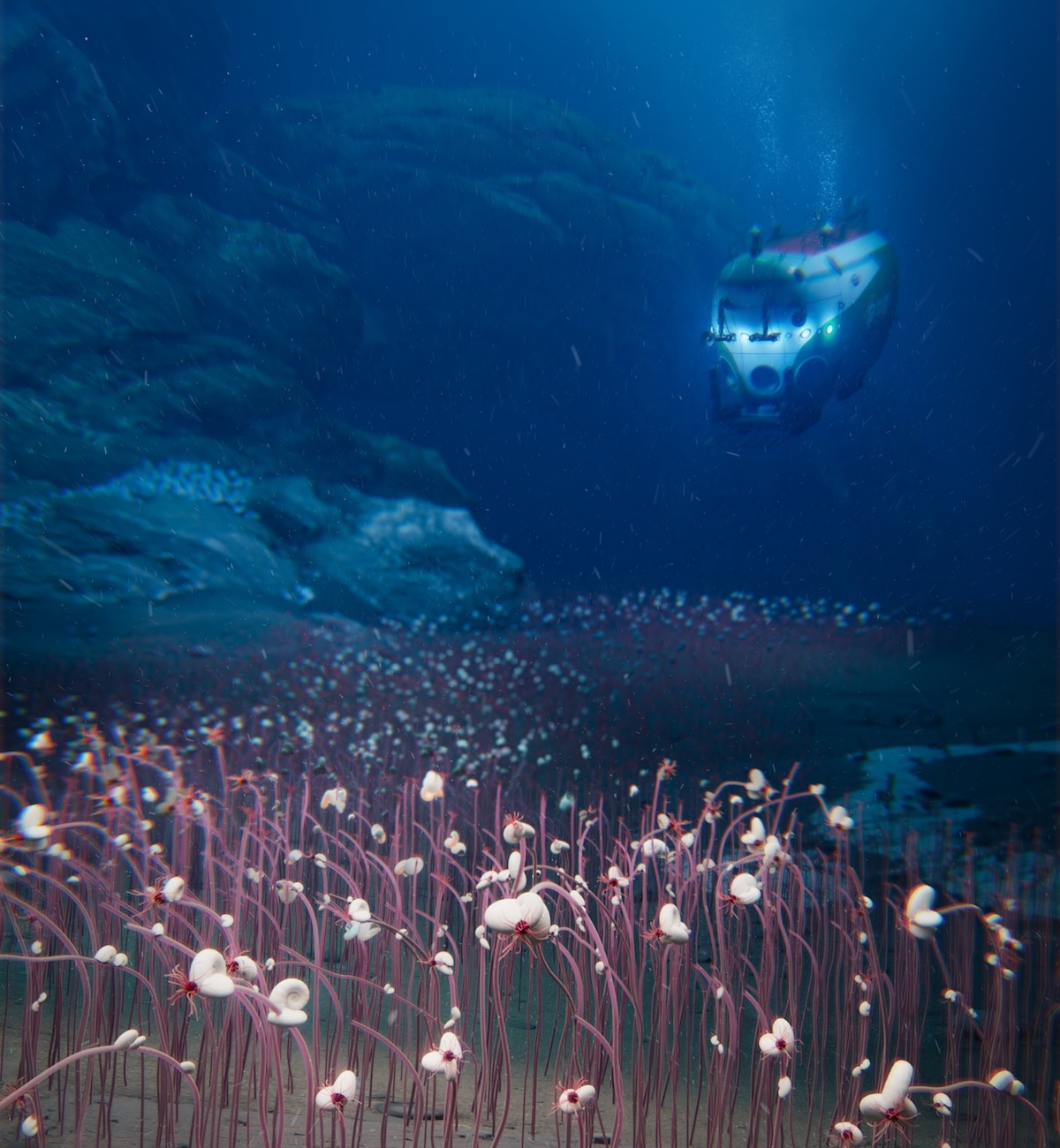
Researchers created this composite image of their submersible deep in the Mariana Trench. Institute of Deep-sea Science and Engineering / Chinese Academy of Sciences

Why you can trust us
Founded in 2005 as an Ohio-based environmental newspaper, EcoWatch is a digital platform dedicated to publishing quality, science-based content on environmental issues, causes, and solutions.
Thousands of mollusks and worms have been discovered by a Chinese submersible in the Mariana Trench, almost six miles below sea level.
The new study revealed it is the deepest colony of animals ever observed.
“Hadal trenches, some of the Earth’s least explored and understood environments, have long been proposed to harbour chemosynthesis-based communities. Despite increasing attention, actual documentation of such communities has been exceptionally rare,” the authors wrote in the findings of the study. “Here we report the discovery of the deepest and the most extensive chemosynthesis-based communities known to exist on Earth during an expedition to the Kuril–Kamchatka Trench and the western Aleutian Trench using the manned submersible Fendouzhe.”
The team of scientists said the discovery in the deepest underwater valley on Earth suggests there could be even more life thriving in hostile conditions far below the surface of unexplored oceans.
“Given geological similarities with other hadal trenches, such chemosynthesis-based communities might be more widespread than previously anticipated,” said lead author of the study Xiatong Peng, as Oceanographic reported.
The newly discovered communities primarily consist of siboglinid Polychaeta and Bivalvia spanning a distance of 1,553.4 miles at depths from 3.6 to 5.92 miles.
“These communities are sustained by hydrogen sulfide-rich and methane-rich fluids that are transported along faults traversing deep sediment layers in trenches, where methane is produced microbially from deposited organic matter, as indicated by isotopic analysis,” the authors of the study wrote.
They said the findings challenge the current models of deep-ocean carbon cycling and life at extreme limits.
No sunlight penetrates at the depths the creatures were found, so instead of getting nutrients through photosynthesis, they live off chemicals like methane that seep through cracks in the ocean floor using a process called chemosynthesis, reported Phys.org.
The Fendouzhe submersible dove into the western Pacific’s Mariana Trench 23 times last year, where the researchers found colonies of thousands of bivalves. The depth of the Mariana Trench extends farther than the height of Mount Everest.
“What makes our discovery groundbreaking is not just its greater depth – it’s the astonishing abundance and diversity of chemosynthetic life we observed,” said study co-author Mengran Du, a marine geochemist with the Institute of Deep-sea Science and Engineering, part of the Chinese Academy of Sciences, as Reuters reported. “Unlike isolated pockets of organisms, this community thrives like a vibrant oasis in the vast desert of the deep sea.”
Video released with the study recorded fields of tubeworms growing up to a foot long, along with mounds of clams and mollusks, reported Phys.org. The scientists also observed free-floating marine worms, spiky crustaceans, sea lilies, sea cucumbers and other invertebrates.
The researchers said they found “compelling evidence” that microbes were producing methane, with tubeworms having a tendency to cluster around snow-like microbial mats.
Earlier studies had discovered communities of single-cell organisms thriving on the seafloor, but few larger animals. However, a remotely operated vehicle did find marine invertebrates such as tubeworms living inside hydrothermal vents 1.24 miles below the floor of the Pacific Ocean in Earth’s crust.
The new findings were published as countries debate the controversial issue of deep-sea mining for valuable minerals. Ocean scientists have warned that mining the little-explored ocean floor could destroy fragile marine ecosystems in one of the last wild zones on the planet. The International Seabed Authority has yet to adopt rules governing the industry, despite recent talks.
Though the first explorers visited the bottom of the crescent-shaped Mariana Trench on a brief expedition in 1960, only a handful have visited since. The first to do so was Hollywood director James Cameron on a solo trip in 2012. He described the environment as “desolate” and “alien.”
“Diving in the submersible was an extraordinary experience – like traveling through time. Each descent transported me to a new deep-sea realm, as if unveiling a hidden world and unraveling its mysteries,” Du said, as Reuters reported.
The findings of the study, “Flourishing chemosynthetic life at the greatest depths of hadal trenches,” were published in the journal Nature.
This surprisingly relaxing footage is from SIX MILES under the ocean – and it’s the deepest ecosystem yet discovered
[image or embed]
— Nature (@nature.com) July 31, 2025 at 11:38 AM
Subscribe to get exclusive updates in our daily newsletter!
By signing up, you agree to the Terms of Use and Privacy Policy, and to receive electronic communications from EcoWatch Media Group, which may include marketing promotions, advertisements and sponsored content.