
Boston-area residents were gripped by fear in the early 1960s, as a serial rapist and killer targeted women in their homes.
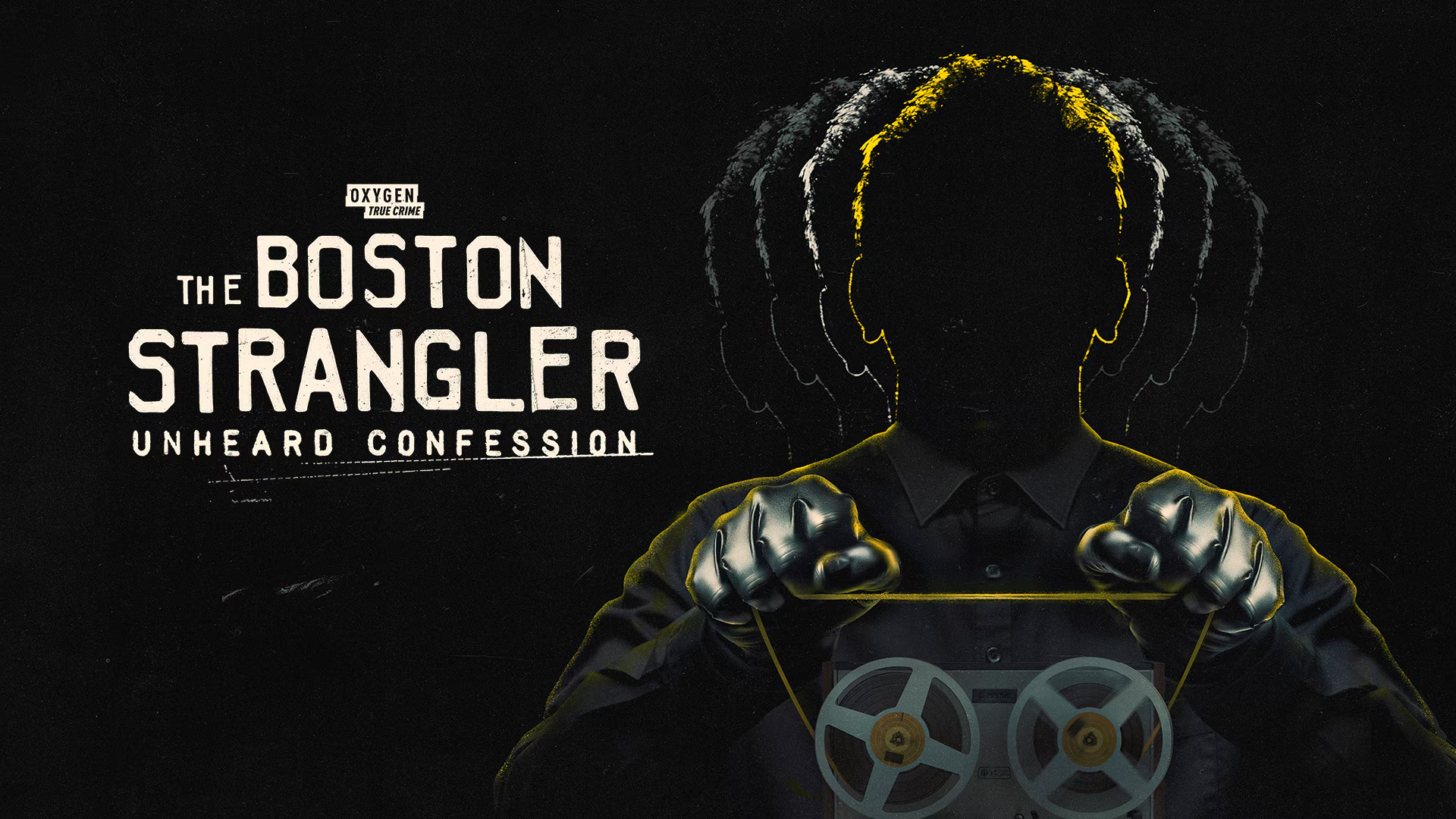
Oxygen’s two-hour documentary The Boston Strangler: Unheard Confession covers this infamous true-crime story and new raises questions about the guilt of Alfred DeSalvo, who admitted to committing the heinous crimes.
“This is an unbelievably complex case,” podcast producer Portland Helmich said in a sneak peek of the intriguing special premiering Sunday, Oct. 26. “This is the first American serial killer case in history.”
What was the Boston Strangler’s calling card?
Between 1962 and 1964, 11 women—ranging in age from 19 to 85—were raped and murdered in their homes.
The Boston Strangler was the nickname given to the unknown assailant whose crimes bore a telltale distinction.
“The signature mark,” said Helmich, “was that the women were strangled with articles of their own clothing tied in the shape of a bow.”
The murders began in the summer of 1962, from June 14 to August 21. “Over a period of two months,” said Helmich, “five women were strangled in Boston.”
Those victims were Anna Slesers, 56, Nina Nichols, 68, Helen Blake, 65, Ida Irga, 75, and Jane Sullivan, 67.
The Boston Strangler’s signature method—or homicidal calling card—was the use of the victim’s own clothing to kill them. Scarves, stockings, and belts were knotted around the victims’ necks.
The initial five victims bore a pattern of their own. “They were older women,” recounted Helmich. “They were white, they were unmarried, and they were living alone.”
In addition to being sexually assaulted with objects and posed after death, the victims shared something else in common.
It seemed that they were letting the killer inside, The Boston Strangler: Unheard Confession noted. There was no forced entry into their apartments.
Boston Police Department Superintendent Bruce Holloway shared the impact of the murders in the documentary. “It paralyzed the city,” he said. “At that time, I lived with my great grandmother in the Roxbury section of Boston. I was about 5 years old. She carried scissors while we’d go walking.”
How did the Boston Strangler murders change?
The case, Holloway recalled, “was very challenging. There was very little evidence recovered in terms of secretions, fingerprints and things of that nature.”
The murders stopped for a while. Then, on December 5, 1962, there was a sixth homicide.
“This one completely turned the case on its head,” said Helmich. “It wasn’t an older woman, it wasn’t a white woman, it wasn’t a woman living alone.”
The victim was Sophie Clark, a 20-year-old African American woman.
The next victims–found between December 1962 and January 1964–were Patricia Bissette, 23, Beverly Samans, 23, Evelyn Corbin, 58, JoAnn Graff, 23, and Mary Sullivan, 19.
“For the last six murders, the M.O. was kind of all over the place,” said Helmich. “The killer raped and ejaculated inside a couple of the women. That hadn’t been the case prior.”
There were also some changes in how women were murdered. “One of the women was stabbed multiple times,” added Helmich. “But there were articles of their own clothing tied in the shape of a bow, and that was the signature mark of the Boston Strangler.
RELATED: Inside John Wayne Gacy’s Double Life: Who Were Series Killer’s Wives?
The Boston Police Department was “absolutely stupefied” by this case, according to the Oxygen documentary.
“They were wondering, is it just one killer,” said Boston Globe reporter Emily Sweeney. “Is it a copycat? Is it possible that there were several different killers?”
In 1965, while behind bars and awaiting trial for a series of unrelated rapes, DeSalvo confessed that he was the Boston Stranger.
DeSalvo was never convicted of being the Boston Strangler. He was killed while incarcerated in 1973.
Through exclusive access to DeSalvo’s unreleased confession tapes, the documentary raises disturbing questions.
As heard in the decades-old recordings, the documentary points out, DeSalvo gets key details wrong and at times seems coached to give specific answers.
So, for some, questions linger. Find out more about those provocative queries in the new documentary.
The Boston Strangler: Unheard Confession premieres Sunday, October. 26 at 6 p.m. on Oxygen.